
Whether to hire IT staff or outsource support is a real decision most growing Kigali businesses face at some point — and the right answer depends on scale and complexity more than on a general preference for one model over the other.
What you’ll learn
- What each model actually offers
- The real cost comparison, beyond the headline number
- Why many businesses land on a hybrid rather than choosing one exclusively
What in-house IT actually offers
A dedicated in-house hire provides physical presence and accumulates deep, specific familiarity with your systems over time. For organisations with complex or highly customised environments, or a genuine need for someone consistently on-site, this familiarity has real value that’s harder to replicate with an external provider working across multiple clients.
What outsourced support actually offers
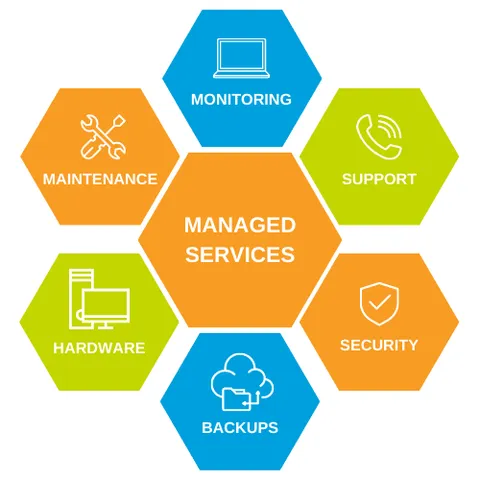
Outsourced, managed IT support provides broader coverage — a team rather than one person, meaning no single point of failure — usually at a lower cost than an equivalent full-time salary, particularly for organisations that don’t need a dedicated IT presence every working hour.
The real cost comparison
A full-time in-house hire costs a salary, benefits, and the ongoing investment of keeping that person’s skills current across an increasingly broad set of technologies. Outsourced support is typically a recurring service fee scaled to your organisation’s size, without those additional employment costs — though it’s worth comparing against your actual support volume, since a very support-intensive environment can make the comparison closer than it first appears.
The single point of failure risk
The most serious, and most common, risk in a single-person in-house IT setup is what happens when that person is unavailable — sick, on leave, or has left the organisation — and nobody else has documented knowledge of the systems they managed. This isn’t a hypothetical; it’s one of the more frequent reasons organisations end up calling in outside help under pressure.
The hybrid middle path
Many organisations land on a combination: an internal person or small team for immediate, day-to-day needs, paired with outsourced coverage for specialist areas (security, servers), after-hours response, or overflow during busy periods. This avoids both the single-point-of-failure risk of relying entirely on one person, and the cost of building a full internal team for coverage you may not need every hour.
Making the decision
The right answer depends on your actual support volume, how specialised your environment is, and whether the risk of one person’s unavailability is one you’re comfortable carrying. If you’re unsure, starting with outsourced support and adding in-house capacity only once volume clearly justifies it is a lower-risk way to find the right balance than committing to a full in-house team upfront.